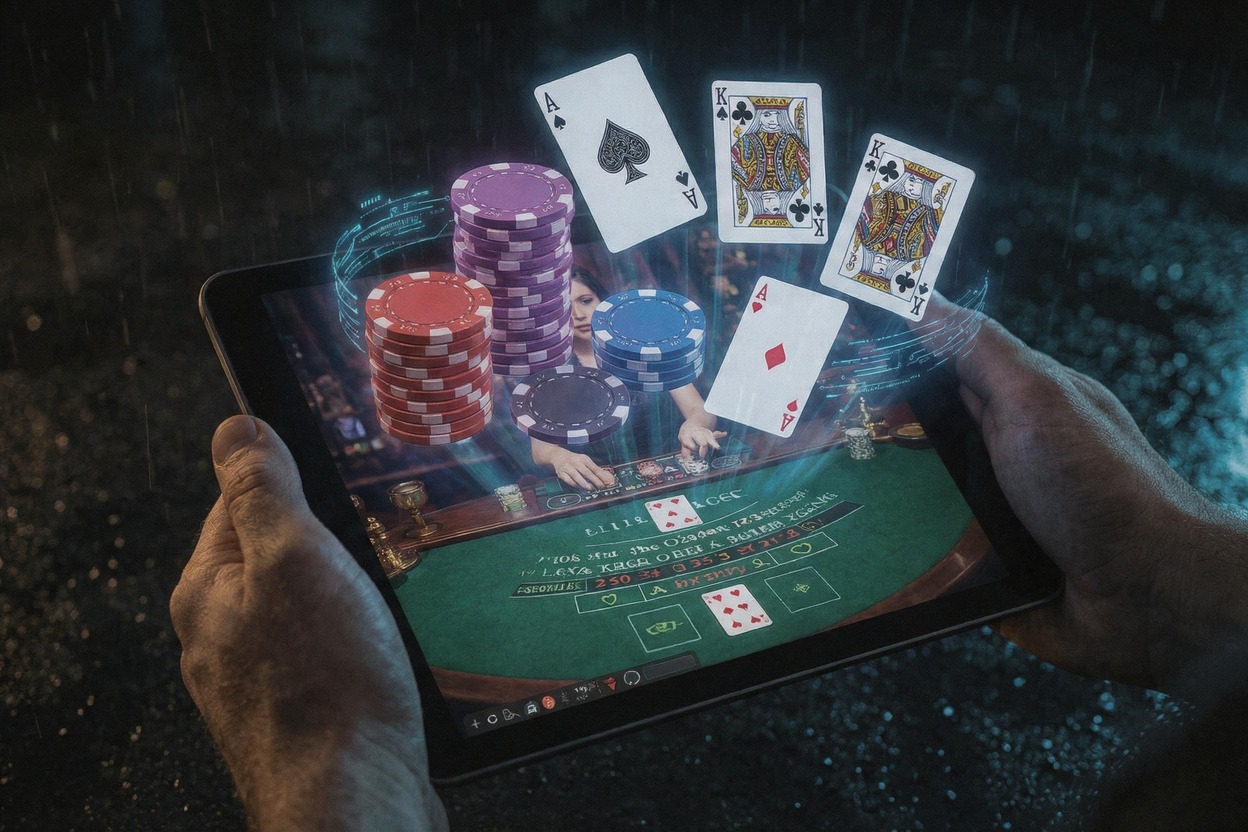
As a senior representative for one of the world’s most advanced gambling ecosystems in 2026, I often witness the astonishment of new players when they realize that the age of the flat screen is effectively over. For decades, the industry struggled to bridge the gap between the physical atmosphere of a Vegas floor and the convenience of mobile play. We initially succeeded with live dealer games, which provided a high-definition window into a studio, but the experience was still transactional and distant. Today, we have achieved the impossible: the materialization of the human element. Through the power of Augmented Reality (AR) and volumetric video capture, the dealer is no longer “behind” a glass pane. They are sitting in your living room, leaning over your actual coffee table, and dealing digital cards that interact with your physical environment.
The Volumetric Revolution: Beyond the Green Screen
To understand how we brought the dealer to your table in 2026, you must look at our studios. We no longer use simple webcams. Our 2026 broadcast centers are equipped with 360 degree volumetric capture arrays. These systems use dozens of ultra-high-speed cameras and LiDAR sensors to record the dealer as a 3D light field rather than a 2D image.
When you launch our AR suite, your device doesn’t just display a video; it receives a data stream of a three-dimensional person. Because the dealer is captured in 3D, you can walk around them. If you are wearing AR glasses or using a high-end smartphone, you can see the side of the dealer’s face, the texture of their suit, and the way the light hits their shoulders. This level of fidelity is what creates “Presence,” the psychological feeling that another human being is physically in the room with you. This presence is the foundation of trust in high-stakes gambling.
Spatial Anchors: Dealing Onto Your Physical Furniture
The magic of AR in 2026 lies in its ability to understand your room. Using the LiDAR sensors that are now standard in almost every mobile device, our software performs a real-time spatial mapping of your environment. It identifies surfaces, such as a wooden desk, a glass table, or even the arm of a couch.
The system then places “Spatial Anchors” on these surfaces. When the AR dealer “places” a card down, the software ensures that the digital card sits perfectly flat on your physical table. If you have a lamp on the table, the digital cards will even cast a shadow on the wood, and the lamp’s light will reflect off the digital card’s surface. This “Occlusion” technology means that if you move your hand over the digital card, your hand appears in front of it, not behind it. This seamless blending of the real and the digital is what makes the 2026 experience so visceral.
The Tactile Feedback of Mixed Reality
As an operator, I know that the greatest hurdle for AR was the lack of touch. In 2026, we have solved this through a combination of hand tracking and mid-air haptics. When the dealer pushes a stack of digital chips toward you, you don’t just see them move.
Our platform integrates with wearable haptic rings or uses ultrasonic transducers built into modern 2026 laptops. As your hand reaches for the digital chips, the sensors track your finger movements with sub-millimeter precision. You feel a “click” or a “pulse” against your skin as you “touch” the holographic stack. This sensory feedback completes the illusion. When you can see the dealer, hear their voice in spatial audio, and “feel” the cards they deal you, your brain stops treating it as a game and starts treating it as a real-world event.
Comparing the Evolution of Dealer Interaction
The transition from 2D to AR has fundamentally changed the metrics of player engagement. Below is a comparison of how the “Live” experience has evolved over the last few years.
| Interaction Feature | 2D Live Stream (2021) | 3D AR Live Dealer (2026) |
| Perspective | Fixed, single-camera angle | Full 360 degree freedom of movement |
| Environmental Context | Studio background only | Your personal physical environment |
| Eye Contact | Simulated (Dealer looks at camera) | Dynamic (Dealer’s gaze tracks your eyes) |
| Card Squeeze | Animation on a screen | Volumetric 3D object on your table |
| Social Presence | Text-based chat | Spatial audio and 3D player avatars |
| Device Hardware | Any screen (Phone/Tablet) | LiDAR-equipped mobile or AR Glasses |
Eye Contact and the Psychology of Trust
In my years representing the casino industry, I have learned that trust is built through the eyes. In a 2D live stream, the dealer looks into a lens, and the player looks at a screen. There is no true eye contact. In our 2026 AR environment, we utilize “Gaze Tracking” on both ends.
The dealer’s headset or studio monitor shows them exactly where you are sitting in your room. As they speak to you, their head turns, and their eyes lock onto yours. Because the AR dealer is a volumetric reconstruction, the gaze is perfect. When a dealer looks you in the eye as they reveal the “River” in Poker or the final card in Baccarat, the tension is identical to a physical casino. This removes the “us vs. them” feeling of a digital app and restores the social contract of a real game.
Spatial Audio: The Sound of the Casino in Your Room
To bring the dealer to your table, we also had to master sound. In 2026, we use Object-Based Spatial Audio. This means that the sound of the dealer’s voice is tied to the 3D coordinates of their hologram.
If you move to the left of the dealer, their voice will sound like it is coming from your right. If the dealer drops a chip on the table, the sound of the “clink” is mapped to the exact spot on your coffee table where the digital chip landed. We even simulate the acoustics of the room you are in. If you are in a large, empty room with echoes, the dealer’s voice will reflect those echoes. This auditory realism is the “silent partner” of the AR visuals, anchoring the dealer to your physical reality.
The Operational Side: Volumetric Studios vs. Traditional Floors
From my perspective as a representative, the shift to AR has also changed how we manage our staff. We no longer build “sets.” We build “capture volumes.” These are white, circular rooms filled with hundreds of sensors.
The dealer doesn’t need to stand behind a heavy wooden table anymore; they stand in the capture volume, and the “table” is added as a digital overlay that matches the player’s table. This allows us to provide a level of variety that was previously too expensive. One player might want the dealer to appear in a classic 1920s tuxedo on a mahogany table, while another might prefer a futuristic, neon-lit dealer on a glass surface. The AR engine renders the environment to match the player’s preference while the human dealer remains the consistent, real-world anchor.
Multiplayer AR: Sharing the Experience
Gambling is a social activity, and in 2026, AR is not a solitary experience. We have introduced “Shared Space” protocols. If you and your friends are in the same physical room, you can all put on your AR glasses and see the same dealer sitting at the same table.
You can see each other’s 3D avatars, and you can see the chips as they move across the table. If a friend “wins” a hand, you see the dealer hand them the chips. This shared digital-physical reality is the ultimate realization of the hybrid casino. It turns a living room into a private VIP lounge. The technology is so advanced that there is no “drift” between players; everyone sees the exact same card in the exact same position on the table, synchronized via 6G ultra-low latency.
Frequently Asked Questions
Do I need a VR headset to play AR live dealer games?
No, VR (Virtual Reality) and AR (Augmented Reality) are different. While you can use “Mixed Reality” headsets like the latest Vision or Quest models, you can also experience AR dealers through a standard 2026 smartphone or tablet equipped with LiDAR. You simply look through your screen as if it were a window, and the dealer appears on the table behind the screen.
Is the dealer a real person or a computer-generated character?
In our 2026 “Live” suites, the dealer is a 100% real human being. They are captured in real-time in a volumetric studio. While we do offer AI-driven dealers for lower stakes, the “Live” experience is defined by the human dealer’s personality, conversation, and real-time physical movements.
Can the dealer see inside my house?
The dealer sees a stylized, low-resolution representation of your spatial map to know where the table and chairs are, but for privacy reasons, they do not see a high-definition video of your home. They see you as a 3D avatar or a simplified video feed, ensuring your personal privacy while still allowing them to make eye contact and interact with your space.
What happens if my cat walks across the AR table?
Modern 2026 AR systems use “Dynamic Occlusion.” If a physical object (like a cat) moves through the digital space, the software recognizes the physical mass. The digital cards or chips will appear to be covered by the cat’s body as it passes over them. Once the cat moves, the digital objects reappear.
Does AR use a lot of battery and data?
Yes, volumetric video is data-heavy. However, in 2026, 6G networks and specialized “AI-processing chips” in mobile devices have optimized this. While it uses more battery than a standard 2D game, it is designed to run efficiently for several hours of play. Most dedicated AR players use a wireless charging stand or a “Mixed Reality” passthrough headset.
How do I “squeeze” the cards in AR?
To squeeze a card, you use a “pinch” gesture in the air. The hand-tracking cameras on your device recognize the movement and translate it into the digital bending of the volumetric card on your table. You can see the card’s value slowly revealed as you “lift” the digital corner with your real fingers.
Is AR gambling legal?
Yes, AR is simply an interface. As long as the casino you are playing at is licensed and regulated in your jurisdiction, the method of display (whether 2D, VR, or AR) does not change the legality of the game itself. In 2026, regulators have specifically approved AR interfaces for their transparency and player-protection features.
Can the dealer hear me talking?
Yes, the audio is two-way. You can speak to the dealer just as you would in a physical casino. In 2026, we also have real-time translation AI, so if you speak one language and the dealer speaks another, the AR system translates your voice in real-time, allowing for a global social experience.
What is the best lighting for AR dealer games?
Standard indoor lighting is best. The LiDAR and camera systems in 2026 are very good at low light, but for the best “shadow” and reflection effects, a well-lit room with a clear table surface provides the most realistic experience. If the room is too dark, the spatial mapping may struggle to find the table edges.
Can I play AR games on the go?
Technically yes, as long as you have a stable 6G connection and a flat surface. However, most players prefer to use AR in a stable environment like a home or a hotel room. If you are on a moving train or bus, the spatial anchors might “drift” as the environment moves around you.
Conclusion
The integration of AR live dealers has finally delivered the “Holy Grail” of online gambling: the ability to bring the human connection of the casino floor into the comfort of the home. As a representative of this 2026 reality, I am proud to say that we have moved past the era of digital isolation. We have created a world where the dealer is your guest, sitting at your table, and sharing the thrill of the game in a way that is physically tangible yet digitally limitless. This is not just a new way to gamble; it is a new way to experience human interaction through the lens of spatial computing.
As we look toward the future, the boundary between “online” and “offline” will continue to vanish. The technology will become even lighter, eventually moving from bulky glasses to sleek contact lenses, but the core principle will remain the same. People want to play with people. By materializing the dealer in your living room, we have restored the heart and soul of the casino experience, ensuring that every hand dealt is a shared, immersive memory. The table is set, the dealer is ready, and they are already waiting for you in your very own home.